








What is OEKO-TEX Standard 100? Textile Safety Certification Explained
OEKO-TEX Standard 100 is a third-party textile safety certification administered by the International OEKO-TEX Association since 1992 that tests every component of a fabric — including thread, dye, print, button, zipper, and trim — against more than 1,000 harmful substances and confirms the material is safe for direct skin contact. Brands earn the certificate by submitting fabric samples to an accredited OEKO-TEX testing institute, paying for chamber testing, and providing a Statement of Conformity for every covered component. Among the brands we carry at Comosum, OEKO-TEX is most relevant to upholstery, cushions, and textile accessories — and where it applies, we name the brand only when the certification is independently verifiable.
OEKO-TEX matters in furniture for one specific reason. The textile is the part of a piece of furniture you actually touch. The cotton on a sofa cushion. The linen on a chair seat. The wool on a throw. Many of those materials are processed with dyes, mordants, finishing agents, and softeners that can include carcinogenic aromatic amines, formaldehyde, heavy metals (lead, cadmium, chromium), pesticide residue from non-organic agriculture, and chlorinated phenols. OEKO-TEX Standard 100 puts a numerical cap on each of those substance categories. A certified textile has been tested and the residue is below the threshold for each.
The greenwashing this certificate addresses is the word "non-toxic" or "natural fiber" used in upholstery marketing without third-party testing of the finished textile. A 100% cotton sofa cover can still carry chemical residue from the dye-and-finish process. OEKO-TEX is the audited version of the textile-safety claim.
What OEKO-TEX Standard 100 actually measures
OEKO-TEX Standard 100 is one certification within a broader OEKO-TEX family that also includes Made in Green (supply-chain transparency on top of Standard 100), Leather Standard (the same approach applied to leather), and STeP (sustainable manufacturing). Standard 100 is the textile-safety certificate specifically.
Testing covers every component of the fabric assembly:
- The fiber itself (natural or synthetic).
- Threads and stitching.
- Dyes and prints, tested against a list of regulated amines including the four classed as known human carcinogens.
- Heavy metals: lead, cadmium, mercury, chromium VI, nickel and others.
- Pesticide residue (for cotton, linen, wool, and other agricultural fibers).
- Formaldehyde — capped at 75 ppm for fabrics with prolonged skin contact and 20 ppm for products intended for babies.
- Chlorinated phenols (PCP, TeCP, TriCP).
- Phthalates in any flexible plasticized component (zips, prints, coatings).
- pH value (a fabric outside a normal pH range can irritate skin).
OEKO-TEX classifies products into four product classes, each with progressively stricter thresholds:
| Product class | Intended use | Threshold strictness |
|---|---|---|
| Class I | Baby and infant articles (up to 3 years) | Strictest |
| Class II | Direct skin contact (clothing, bedding) | Very strict |
| Class III | No or limited skin contact (jackets, lined goods) | Standard |
| Class IV | Decorative materials (curtains, tablecloths, upholstery covers not in continuous skin contact) | Least strict, still regulated |
What OEKO-TEX Standard 100 does not measure. It does not certify the wood, metal, or other non-textile components of a piece of furniture. It does not certify factory labor practice — for that, look at B Corp or SA8000. It does not certify the environmental impact of the dyeing process — that is what OEKO-TEX STeP covers. It does not test for microfiber shedding or end-of-life recyclability. Standard 100 is specifically about substances on or in the textile that come into contact with a human body.
How verification works
The International OEKO-TEX Association, headquartered in Zurich, accredits a network of independent testing institutes worldwide — Hohenstein Institute (Germany), TESTEX (Switzerland), Centrocot (Italy), and others. The manufacturer submits fabric samples to an accredited institute, the institute runs the substance panel against the thresholds for the relevant product class, and the certificate is issued if every substance falls under its cap.
Every OEKO-TEX certificate carries a unique number in the format of a long alphanumeric string (test number plus institute code), publicly searchable at oeko-tex.com. The lookup returns the certificate holder, validity period (certificates are issued for one year and renewed annually), product class, and the specific articles covered. If a brand makes an OEKO-TEX claim and cannot produce the certificate number, the claim is not verifiable.
Which Comosum brands carry OEKO-TEX textiles
OEKO-TEX coverage in the furniture category is brand-by-brand and often product-by-product. We are conservative about naming brands here: where the OEKO-TEX certificate is on the brand's textile mill rather than the brand itself, we describe the relationship rather than implying brand-level certification.
Among the brands we carry that use textiles in their products:
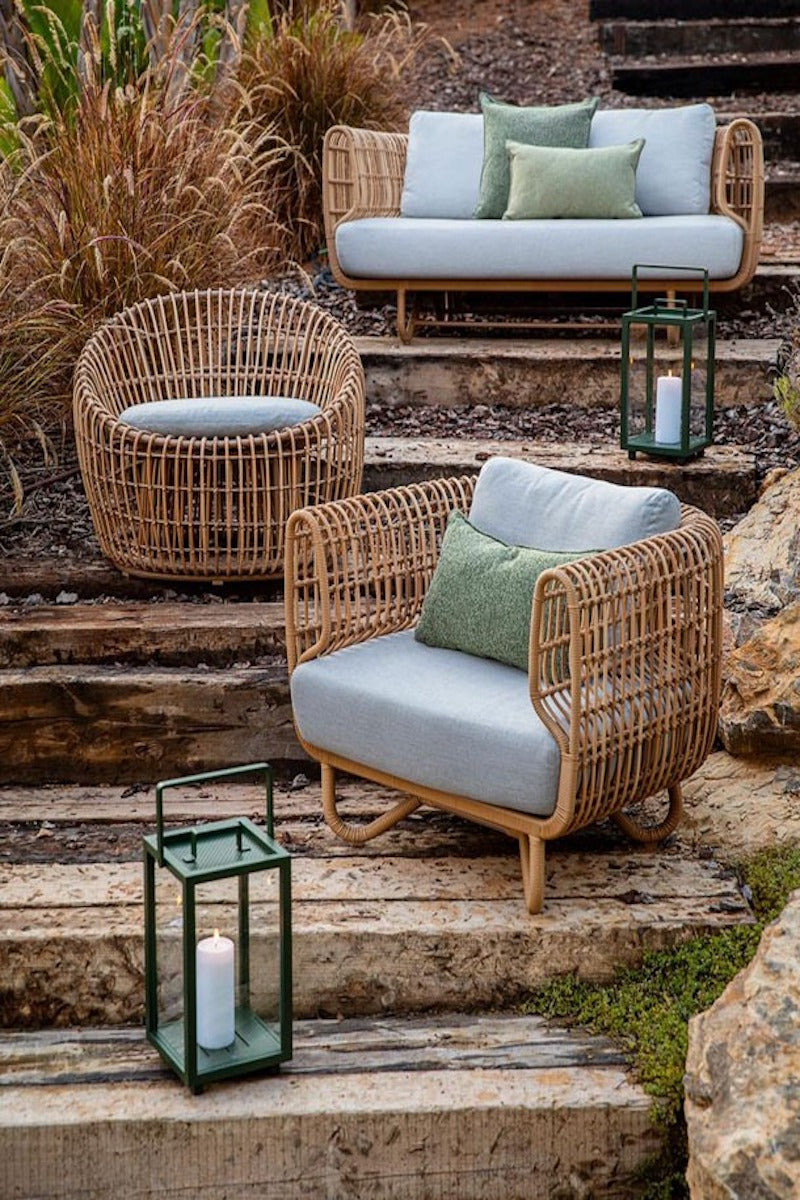
- Several upholstery fabrics specified on Cane-Line outdoor furniture are certified to OEKO-TEX Standard 100 at the textile-mill level. For a specific Cane-Line SKU, the upholstery option specification will list the textile name; cross-reference that name in the OEKO-TEX directory for the certificate.
- Mater sources upholstery textiles from European mills that commonly hold OEKO-TEX certification; the certificate sits with the mill rather than with Mater.
We deliberately do not list a longer set of brands here without verifying the specific certificate at the SKU level. Among the brands we carry, OEKO-TEX is more often a mill-level signal than a furniture-brand-level signal, and we want this guide to reflect that distinction honestly.
If you are shopping for a specific upholstery option on a Comosum product page and want to confirm the textile carries OEKO-TEX Standard 100, the fastest path is to check the product spec for the fabric name (commonly an alphanumeric code from the supplier mill) and search that name at oeko-tex.com.
How to verify a brand's OEKO-TEX claim yourself
Go to oeko-tex.com and use the certificate search. You can search by certificate number, by brand name, or by article name. The lookup shows the certificate holder, the product class (I through IV), the issuing testing institute, the validity period, and the specific covered articles. If the certificate is held by the textile mill (most common) and a furniture brand is selling the textile as an upholstery option, the certificate name on the OEKO-TEX directory will match the mill or supplier, not the furniture brand itself.
Where OEKO-TEX sits in the Comosum Sustainability Meter
The Sustainability Meter is our six-dimension rubric — Durability, Energy, Labor, Manufacturing, Material, and Transportation — applied to every product we consider carrying. OEKO-TEX Standard 100 feeds the Material dimension specifically. For products with significant textile content (upholstered seating, fabric headboards, soft furnishings), an OEKO-TEX certified textile is the third-party signal we look for in the same way we look for FSC on wood and GREENGUARD Gold on finish chemistry. For products with no textile component, OEKO-TEX is not scored.
Frequently asked questions
What does OEKO-TEX Standard 100 cost a brand to obtain?
The cost is borne primarily by the textile manufacturer, not the furniture brand. Certification fees from an accredited institute typically run several thousand euros per article family per year, with annual renewal. The certificate is held by the mill or supplier, and any furniture brand using a certified textile inherits the cert at the SKU level for the duration of the certificate.
How often is OEKO-TEX Standard 100 renewed?
Annually. Certificates are issued for one year and must be renewed each year through re-testing. The annual renewal is part of why the OEKO-TEX directory is the only reliable way to confirm a current claim.
Is OEKO-TEX Standard 100 the same as GOTS organic?
No. OEKO-TEX Standard 100 tests the finished textile for harmful substances regardless of how the fiber was grown. GOTS (Global Organic Textile Standard) certifies that the fiber was produced organically and that the processing chain meets specific environmental and social standards. The two stack: a textile can hold both, and many high-end natural-fiber upholstery options carry both certificates.
Do all sustainable furniture brands carry OEKO-TEX?
No. OEKO-TEX is primarily a textile-mill certification, and it appears on furniture brands' products when the specified upholstery fabric was sourced from an OEKO-TEX certified mill. Brands that work mainly in solid wood, metal, or non-textile materials will not commonly hold OEKO-TEX. Where the cert matters is upholstery, cushions, throws, and bedding.
What happens if a textile loses OEKO-TEX certification?
The mill can no longer label that textile with the OEKO-TEX mark. Any furniture brand currently using that textile typically has notice from the mill and may switch to an alternative certified textile. Loss usually happens at re-test if a substance exceeds threshold (often due to a process change at the dye stage), or if the mill does not renew on time.
Is OEKO-TEX certified furniture safe for a baby's room?
For baby and infant goods, look specifically for OEKO-TEX Standard 100 Product Class I — the strictest tier. A Class I certified textile has been tested against the tightest substance thresholds in the OEKO-TEX framework. Pair the textile cert with GREENGUARD Gold on the finished piece (for finish chemistry) and FSC on any wood components (for source).
The shortest version of this guide: OEKO-TEX Standard 100 is the credible textile-safety signal. Use it on upholstered seating, cushions, and any product where a fabric sits against the skin. Pair it with FSC for wood source, GREENGUARD Gold for finish chemistry, and B Corp for company practice.
To browse upholstery and textile products at Comosum, start with the seating collection and check the fabric specification on each SKU. For the rubric that combines OEKO-TEX with the other signals into a single product-level score, read the Sustainability Meter methodology. For the full overview of all seven certifications that matter in 2026, see our Sustainable Furniture Certification Glossary.
Comosum is also a proud member and advocate of Be Original Americas, the leading organization dedicated to supporting and protecting original design. Be Original Americas promotes the economic, ethical, and environmental value of authentic design, encouraging both creators and consumers to understand why originality matters. Through our membership, we stand alongside a global community that values creativity, innovation, and craftsmanship.
Being part of Be Original Americas reinforces our belief that great design should respect its creators and the planet. It’s a commitment to authenticity — ensuring that every piece we offer honors the artistry, sustainability, and integrity that define original design.
Comosum is also a proud member and advocate of Be Original Americas, the leading organization dedicated to supporting and protecting original design. Be Original Americas promotes the economic, ethical, and environmental value of authentic design, encouraging both creators and consumers to understand why originality matters. Through our membership, we stand alongside a global community that values creativity, innovation, and craftsmanship.
Being part of Be Original Americas reinforces our belief that great design should respect its creators and the planet. It’s a commitment to authenticity — ensuring that every piece we offer honors the artistry, sustainability, and integrity that define original design.