












Comosum Sustainability Meter: A Six-Dimension Furniture Rubric
Comosum’s Sustainability Meter is a six-dimension framework — Durability, Energy, Labor, Manufacturing, Material, Transportation — that scores every piece of furniture we consider carrying. Products that hit our minimum threshold on every dimension AND a minimum total score earn a Sustainability Meter badge and are stocked. Everything else is rejected. This is the full methodology, published openly.
We built the meter because most “sustainable furniture” claims in the industry are unverifiable. The large environmental certifications — FSC, B Corp, GREENGUARD, ISO 14001, OEKO-TEX, Cradle to Cradle — each measure something real and something different, and none of them combine into a single buyer-friendly signal at the product level. The meter is Comosum’s attempt to make sustainability legible where the buying decision actually happens: on the product page, in front of a number. We publish the methodology so customers can audit our scoring, so other retailers can adopt or critique the framework, and so we can’t quietly relax a threshold once it’s in writing.
The six dimensions
Each dimension scores from 1 (a fatal flaw or absent practice) to 5 (best-in-class, third-party-audited, brand-leadership behavior). Scores are integers. The six dimensions are weighted equally in the total: a maximum total score is 30. Everything below is the scoring rubric.
Durability
What we measure. Expected useful lifespan under typical residential use, including the brand’s repair commitments, parts availability, and material reparability.
A 1-star product might last three to five years — mass-produced upholstery with stapled joints, MDF case goods that swell once they meet humidity, finishes that scratch and can’t be touched up. A 5-star product is engineered for multi-decade or multi-generational use: solid-wood joinery that can be sanded and refinished, replaceable parts kept in stock by the brand, mechanical fasteners instead of structural adhesives, and a brand-level lifetime guarantee on the load-bearing components.
The third-party signals that feed the durability score include brand-published lifetime guarantees, documented parts-availability programs, and certifications adjacent to longevity such as the Sustainable Furnishings Council’s repairability criteria.
Worked examples from the Comosum catalog: Anglepoise offers a lifetime guarantee on the mechanical components of the Original 1227 lamp — a piece that has stayed in continuous production since 1935 — which would score at the top of this dimension. Ethnicraft’s FSC-certified solid-oak dining tables, designed to be sanded and re-oiled rather than discarded, would also score at the top. A fast-fashion fiberboard sideboard with stapled joinery would sit at the bottom.
Energy
What we measure. Manufacturing energy intensity per unit, the proportion of renewable energy in the production mix, and the presence of audited environmental-management certifications on the facilities making the product.
A 1-star product is made in an unnamed facility with no published energy data and no environmental-management certification — the default state of the industry. A 5-star product comes from a facility that holds ISO 14001 certification, runs on documented renewable energy, and is owned by a brand carrying B Corp Climate Positive status or equivalent third-party verification.
The signals we score are ISO 14001 (the international standard for environmental management systems, which audits waste, energy, water, and emissions across a facility), Sustainable Furnishings Council ratings that include energy criteria, B Corp Climate Positive status, and brand-published renewable-energy percentages for the manufacturing sites.
Worked examples: Fermob has held ISO 14001 since 2010 across its three manufacturing sites near Lyon, and would score high on this dimension. Ethnicraft’s Belgian headquarters runs on solar power and its Serbian factory is heated and powered in part by wood-residue energy drawn from its own production waste, which would score high. A brand with no facility certifications and no published energy story sits at the bottom.
Labor
What we measure. Working conditions in the production facilities, fair-wage compliance, the brand’s willingness to name the factory and city where the product is made, and partnerships with sheltered-workshop or social-enterprise programs.
A 1-star product is made in an offshore facility that the brand will not name, in a country with no published wage data and no third-party labor audit. A 5-star product is made in a named factory in a country with binding labor law, audited against B Corp’s “Workers” impact area or an equivalent third-party standard, and where appropriate the brand partners with established social-enterprise programs such as France’s ESAT network (Établissements et Services d’Aide par le Travail, sheltered workshops that employ workers with disabilities).
The signals we score are B Corp certification (which includes a dedicated Workers assessment), named factory locations at the SKU level, fair-wage compliance documentation, SA8000 or equivalent labor-audit certifications, and documented ESAT-type partnerships.
Worked examples: Tiptoe’s French ESAT assembly partnerships, where parts of the catalog are assembled by sheltered workshops in France, would score at the top of this dimension. Anglepoise and Case Furniture — both certified B Corps — would score high. A brand that lists “imported” with no country and no factory name sits at the bottom.
Manufacturing
What we measure. Process integrity in how the product is built — finishes used, joinery method, repairability of the construction, and whether the architecture allows for disassembly at end-of-life.
A 1-star product is finished with solvent-based wet paint, joined with structural adhesives that cannot be reversed, and built so that no individual component can be replaced without scrapping the whole piece. A 5-star product uses powder-coat or water-based finishes, mechanical fasteners only (so the piece can be disassembled and re-assembled), and is documented to allow component-level replacement.
The signals we score are powder-coat versus wet-paint finishes, mechanical fasteners versus structural adhesives, GREENGUARD Gold certification (which tests the finished product against the strictest published VOC-emissions thresholds), CARB Phase 2 compliance for composite-wood components, and the brand’s published parts-replacement program if one exists.
Worked examples: Heller’s mechanical-fasteners-only architecture, designed to allow full disassembly of its 100%-recyclable polyethylene seating, would score at the top. Fermob’s powder-coating process — covered by the brand’s ISO 14001 certification, which audits the solvent, off-gas, and waste streams from that specific production step — would score high. A solvent-wet-paint finish on adhesive-joined MDF sits at the bottom.
Material
What we measure. Source certification of the raw inputs, the proportion of recycled content with documented post-consumer percentages, indoor-air-quality emissions testing on the finished material, and species-level disclosure for wood.
A 1-star product uses generic “wood” with no species and no certification, conventional foam with no flame-retardant disclosure, and textiles with no air-quality data. A 5-star product carries FSC certification on every wood component, GREENGUARD Gold on the finished piece, OEKO-TEX Standard 100 on the textiles, and publishes the post-consumer recycled-content percentage for any plastic, metal, or fiber input.
The signals we score are FSC (100%, Mix, or Recycled), GREENGUARD Gold, OEKO-TEX Standard 100, documented post-consumer recycled content, CARB Phase 2 for composite wood, and species-level naming on every wood SKU.
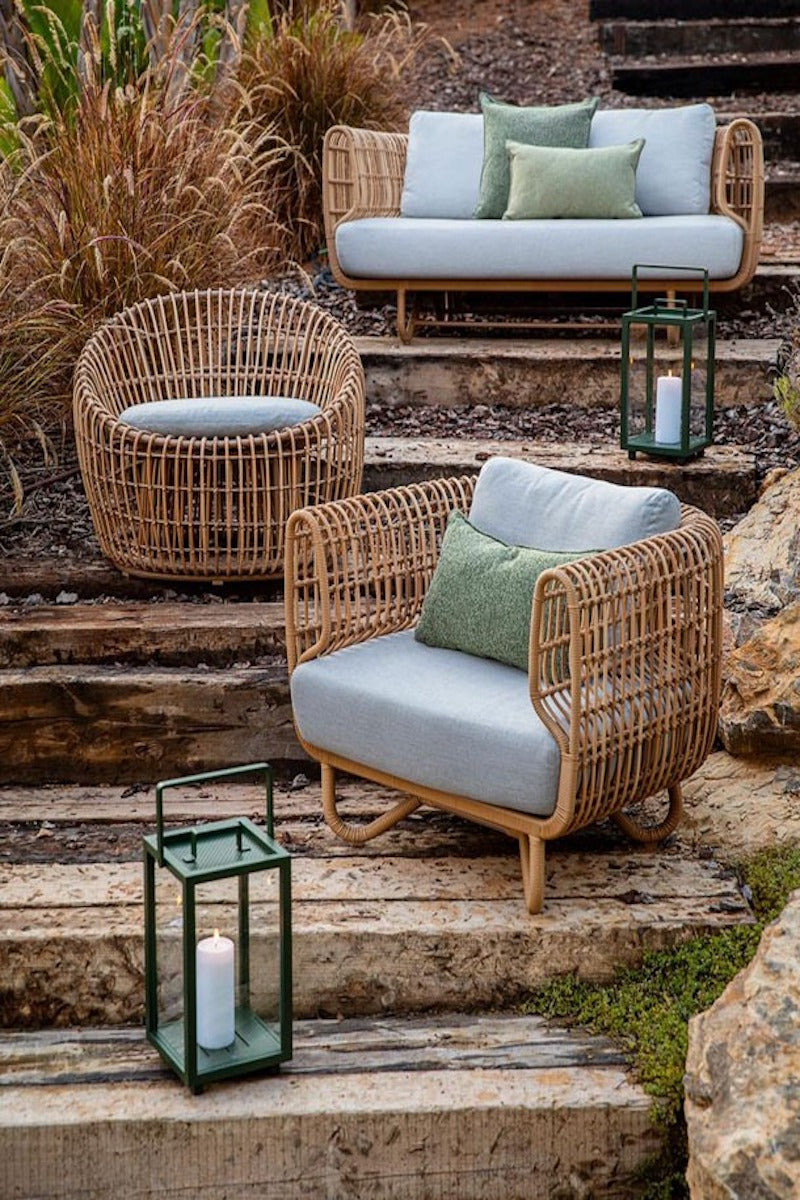
Worked examples: Ethnicraft’s FSC-certified solid oak and teak case goods would score at the top of this dimension. Cane-Line’s FSC-certified teak — paired with the brand’s proprietary Cane-line Soft Touch recyclable fiber — would score high. A brand that lists “wood” on a sideboard with no FSC certificate and no species name sits at the bottom of the dimension; the meter would penalize that listing even if the rest of the brand’s catalog scored well.
Transportation
What we measure. Distance from the factory to the US delivery point, the recyclability of the packaging that carries the piece, and whether the product ships flatpack or fully assembled.
A 1-star product is shipped fully assembled in mixed-material packaging, direct from a non-US factory with no intermediate US warehouse — a long shipping route with low container density and packaging that can’t be recycled. A 5-star product is made in the US (or held in a US warehouse for last-mile freight), ships flatpack to maximize container density, and arrives in recyclable mono-material packaging.
The signals we score are factory-to-US-warehouse distance, presence of a US warehouse versus direct international shipping, flatpack-versus-assembled ship format, and packaging composition.
Worked examples: Heller, made in New York, would score at the top of this dimension. Cane-Line ships from Denmark but is held in Comosum’s US warehouse, which moderates the shipping footprint for the last mile — a mid-range score. Isimar ships direct from Spain on a four-to-six-week ocean lead time and would score lower on this dimension; the rest of the brand’s profile is strong enough to clear the threshold, but the meter is honest about where the friction sits.
How a product earns a Sustainability Meter badge
The badge is binary — a product either earns it and is stocked, or it does not and we walk away. Three rules govern the badge.
Rule 1 — no fatal flaw in any single dimension. Every dimension must score at least 2. A product that scores 1 on Labor or 1 on Material cannot be saved by high scores elsewhere. This is the rule that screens out the largest set of would-be products: a brand might score brilliantly on Material and Manufacturing but refuse to disclose the country of assembly, and that’s a 1 on Labor and a hard no.
Rule 2 — minimum total score of 18 out of 30. Across the six dimensions, the product must hit a total of at least 18. This is a 60% bar. We chose 18 because it forces a product to be at least average on most dimensions and strong on a few — a flat row of 3s clears the bar, but a row of 2s with one 5 does not.
Rule 3 — Material and Manufacturing must each score at least 3. We do not compromise on what the product is made of or how it is built. A piece can sit at 2 on Transportation (it ships from Europe), 2 on Energy (the facility isn’t ISO 14001), and still earn the badge if Material and Manufacturing are both at 3 or higher. The reverse — high Energy and Transportation scores with weak Material or weak Manufacturing — does not.
Worked examples
Fermob Bistro chair. Durability 5 (lifetime structural integrity, replaceable parts, in continuous production since 1889). Energy 4-5 (ISO 14001 since March 2010, three manufacturing sites in Thoissey/Anneyron/Mâcon). Labor 4 (named French facilities, French labor law). Manufacturing 5 (zero-waste solvent-free powder coat over steel, mechanical fasteners). Material 4 (steel with recyclable powder coat; no FSC since there’s no wood; full material disclosure). Transportation 3 (ships from France via Comosum’s US warehouse). Total ~25/30. Earns the badge.
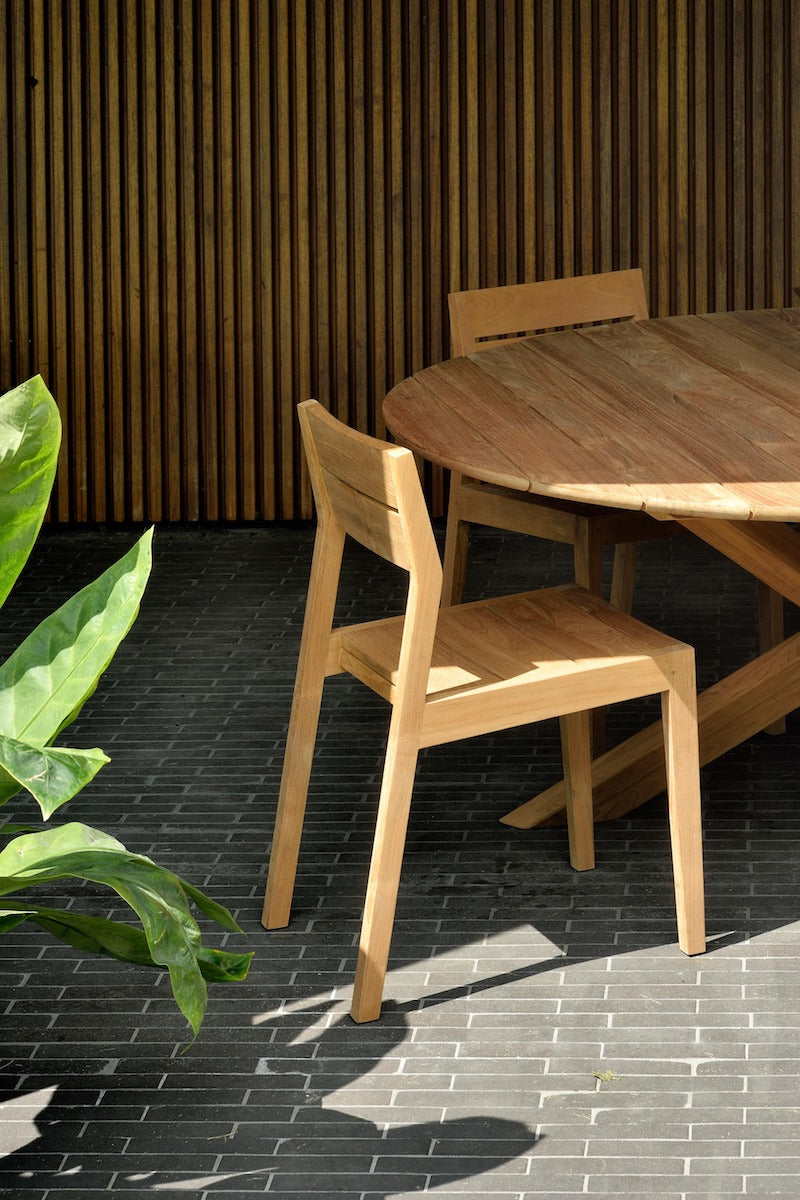
Ethnicraft FSC oak dining table. Durability 5 (solid wood, sand-and-refinish architecture, multi-decade use). Energy 4 (solar headquarters, wood-residue Serbian factory). Labor 4 (named Belgian and Serbian facilities). Manufacturing 4 (mechanical joinery, low-VOC oil finishes). Material 5 (FSC-certified oak, species named, low-VOC oils). Transportation 3 (ships from Europe, held in US warehouse). Total ~25/30. Earns the badge.
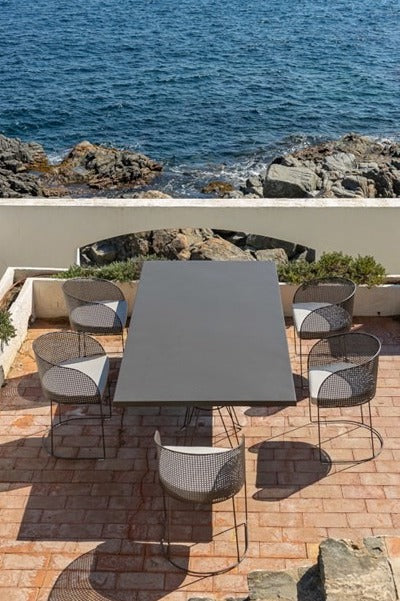
Isimar outdoor chair. Durability 4 (galvanized and powder-coated steel, designed for European municipal use). Energy 3 (Spanish factory in Noáin, Navarra; no published ISO 14001). Labor 3 (named factory, Spanish labor law). Manufacturing 4 (powder coat over galvanized steel, mechanical fasteners). Material 4 (recyclable steel substrate, powder coat). Transportation 2 (ships direct from Spain, no US warehouse buffer). Total ~20/30. Earns the badge, but Transportation 2 is honest: if you need the piece on a short timeline, the meter would point you toward Fermob or Cane-Line.
We score every candidate brand against the rubric before we accept it into the catalog, and we publish the score on the product page so the buyer can read it the same way we read it.
What the meter doesn’t measure
A rubric is only credible if it’s honest about its gaps. The meter does not measure:
Subjective design quality. We curate for design separately — the sustainability page explains the editorial filter, and the meter is downstream of that. A product can score 30/30 on the meter and still not earn shelf space if the design isn’t good enough; the meter handles “is this responsibly made” and editorial curation handles “is this worth specifying.”
Full lifecycle CO2. A complete life-cycle assessment (LCA) requires emissions data across raw-material extraction, manufacturing, transport, use phase, and end-of-life. We don’t have audited LCA data for every brand we carry, and we’d rather report nothing than report a guess. The meter is a structured proxy for lifecycle impact, not a substitute for it.
Customer use behavior. A 30/30 chair used as a coat rack for six months and then discarded is still being misused. The meter scores the product as the customer receives it; we can’t score what happens next.
End-of-life behavior after disposal. We recommend repair-first and operate brand-level repair pathways where they exist (Ethnicraft’s Re-Loved program, Anglepoise’s lifetime mechanical guarantee), but we can’t enforce repair or take-back once a piece is in a customer’s home.
Carbon offsetting. The meter scores reductions, not offsets. A brand that buys credits to claim carbon-neutral status gets no credit on Energy unless the underlying facility data justifies the score.
Owning these gaps is what makes the meter credible. A rubric that claims to measure everything ends up measuring nothing.
How the meter compares to other rubrics
The meter is not a replacement for industry certifications — it folds them in. The major adjacent frameworks and where they sit relative to the meter:
FSC (Forest Stewardship Council) measures forest-source integrity. Folded into Material, weighted heavily, but Material also captures recycled content, OEKO-TEX, and CARB Phase 2 — which FSC doesn’t address.
B Corp measures company-level practice across five impact areas. Folded into Labor, Manufacturing, and Energy. B Corp scores the company; the meter scores the product.
GREENGUARD Gold measures indoor air-quality emissions against the strictest published thresholds for schools and healthcare. Folded into Material and Manufacturing — one of the strongest single signals.
ISO 14001 certifies a facility’s environmental-management system. Folded into Energy primarily, secondary weight on Manufacturing.
Cradle to Cradle measures full-lifecycle circularity. C2C is the most ambitious published rubric; the meter borrows from it conceptually but C2C is product-by-product and brand-applied-for, which limits coverage in practice.
Sustainable Furnishings Council (SFC) ratings grade brands on sustainable practices across the catalog. The meter treats SFC ratings as a strong signal across Energy, Material, and Manufacturing.
The meter’s contribution: combining these signals into a single buyer-facing number, applying it uniformly across the catalog, publishing the score on every product page. No existing rubric does all three.
Why we publish the rubric
Three reasons.
Customer transparency. A score on a product page is worth less if the customer can’t audit how the score was reached. Publishing the rubric means a buyer can read the meter score on an Ethnicraft sideboard, click through to this page, and reconstruct the math.
Industry pressure. The European sustainable-furniture category in the US is shaped by a small set of editorial sources — The Good Trade, LeafScore, Treehugger, EcoWatch — and a smaller set of certification bodies. None of them publish a buyer-friendly per-product rubric for furniture. Putting one in the open invites other retailers to adopt the framework, fork it, or argue with it. That conversation is good for the category.
Our own accountability. A private rubric can be quietly relaxed when a tempting brand fails the threshold. A public rubric can’t. Publishing the meter is a commitment to ourselves as much as to the customer: if a product scores 17/30, we walk away from the brand, and the rule is on the record.
Applied examples of the meter in action
We’ve already used the meter to shape the catalog, and the four preceding pillar guides each look at how a slice of the catalog scores against it.
- Best European Sustainable Furniture Brands You Can Buy in the US walks through sixteen European houses and the certifications behind each — read it for the brand-level view of how the meter scores Material, Energy, and Labor across the European catalog.
- Sustainable Outdoor Furniture from French, Danish, and Spanish Brands is the meter applied to outdoor — where Transportation, Material, and Manufacturing are the load-bearing dimensions.
- Scandinavian Sustainable Design: A US Buyer’s Guide is the meter applied to the Danish and Norwegian catalog, where Durability and Material tend to be the strongest scoring dimensions.
- Mid-Century Reissues, Done Sustainably is the meter applied to licensed reissue programs — Heller, Anglepoise, FDB Møbler — where Durability and Manufacturing are load-bearing and where “is the reissue actually built like the original” is the question the meter is built to answer.
Frequently asked questions
What is Comosum’s Sustainability Meter?
The Sustainability Meter is a six-dimension scoring rubric — Durability, Energy, Labor, Manufacturing, Material, Transportation — applied to every product Comosum considers carrying. Each dimension scores from 1 to 5 (integers), for a maximum total of 30. A product must clear minimum thresholds on every dimension and a minimum total score to earn a badge and a place in the catalog.
How many points does a product need to be carried?
A product needs three things: a score of at least 2 on every dimension (no fatal flaw in any single area), a total score of at least 18 out of 30 (60%), and a score of at least 3 on Material and on Manufacturing (we don’t compromise on what the product is made of or how it is built). A product missing any one of those three conditions is rejected.
What happens if a product scores high overall but fails one dimension?
It is rejected. The “no fatal flaw” rule means a single 1-star dimension cannot be averaged away by strong scores elsewhere. A piece that scores 5 on Material, 5 on Manufacturing, 5 on Durability, and 1 on Labor (because the brand will not name the factory) does not earn the badge.
Do you re-score products over time?
Yes. Brands change. A factory adds ISO 14001 certification, or a brand drops a wood species without FSC certification. We re-score the affected product when we become aware of a material change and update the badge on the product page accordingly. Annual re-scoring is the goal for the full catalog.
Can other retailers use the Sustainability Meter framework?
Yes. The meter is published openly because we want other retailers to adopt or critique it. We ask only that the framework be attributed to Comosum when it is republished or referenced, and that any modified version make the modifications explicit.
How does the meter handle products from B Corp brands?
B Corp certification is a strong signal but not a guaranteed pass. B Corp folds into Labor, Manufacturing, and Energy in the meter — it carries weight in three dimensions out of six. A B Corp brand with poor Material disclosure or long-haul Transportation can still fail the threshold; a non-B-Corp brand with strong scores across the other dimensions can still pass.
Why don’t you use a lifecycle CO2 number instead?
A complete LCA requires audited emissions data across raw-material extraction, manufacturing, transport, use phase, and end-of-life. That data does not exist for most of the brands we carry, and we would rather publish a structured proxy than a single number with a wide error bar. The meter is honest about being a proxy.
Where do I see a product’s Sustainability Meter score on the site?
The badge appears on the product page (PDP) for every stocked item. Clicking the badge opens a breakdown of the six dimension scores. The badge is also visible on collection pages as a small overlay on the product card.
Browse the full Comosum catalog at /collections/all — every product visible has earned a Sustainability Meter score. The methodology is open; the catalog is the proof.
Comosum is also a proud member and advocate of Be Original Americas, the leading organization dedicated to supporting and protecting original design. Be Original Americas promotes the economic, ethical, and environmental value of authentic design, encouraging both creators and consumers to understand why originality matters. Through our membership, we stand alongside a global community that values creativity, innovation, and craftsmanship.
Being part of Be Original Americas reinforces our belief that great design should respect its creators and the planet. It’s a commitment to authenticity — ensuring that every piece we offer honors the artistry, sustainability, and integrity that define original design.
Comosum is also a proud member and advocate of Be Original Americas, the leading organization dedicated to supporting and protecting original design. Be Original Americas promotes the economic, ethical, and environmental value of authentic design, encouraging both creators and consumers to understand why originality matters. Through our membership, we stand alongside a global community that values creativity, innovation, and craftsmanship.
Being part of Be Original Americas reinforces our belief that great design should respect its creators and the planet. It’s a commitment to authenticity — ensuring that every piece we offer honors the artistry, sustainability, and integrity that define original design.