
Scandinavian Sustainable Design — A US Buyer's Guide (2026)
In 1944, Børge Mogensen drew a dining chair for the Danish Cooperative Movement. Eighty-two years later, FDB Møbler is still making it — same design, same brief, now in FSC-certified oak. That single fact is the through-line of this guide.
Scandinavian design carries two reputations now. One is an aesthetic, copied to cliche by flat-pack chains and rental-staging companies. The other is a sustainability lineage, and it has not been copied. It still lives with a tight cluster of Danish and Norwegian houses that have been producing the same chairs, vases, glasses, and stools for forty, eighty, or two hundred years.
Comosum carries nine of those houses, US-stocked. Each is rated on the Comosum Sustainability Meter — see Pillar 5 for the full rubric. This guide names every brand, every key designer, and the rule for telling Scandinavian from Scandinavian-inspired.
The most sustainable object is the one that does not get redesigned every five years.
What separates Scandinavian from Scandinavian-inspired
Four tests. Each one separates a real sustainability story from a marketing one.
1. Continuous-production heritage
A piece that has been made for decades has already proven it outlasts trend cycles. The J39 chair has run since 1944. Mouth-blown glass at Holmegaard has run since 1825. Nothing else signals durability as clearly.
2. Verified certifications
Every brand here holds B Corp, FSC, or sits inside a B Corp parent. Soft language — "Scandinavian-inspired," "Nordic-minimal," "eco-conscious" — does not count. For the full grading rubric, see Pillar 5: the Sustainability Meter.
3. Named designers, model numbers, archives
Børge Mogensen designed the J39. Per Lütken designed a generation of Holmegaard glass. Kay Bojesen designed the wooden Monkey in 1951. Peter Opsvik designed the Variable balans stool in 1979. A real archive names names.
4. US warehouse availability
Every brand below ships from Comosum's US warehouse on domestic freight. Otherwise you wait six to twelve weeks on ocean freight from Copenhagen.
The nine brands
Danish furniture houses
- FDB Møbler (Denmark, 1942) — Founded by the Faglige Brugsforeningers Konsumforening, Denmark's consumer cooperative. Built to put well-designed furniture in working households, not collectors'. The deepest single brand at Comosum: roughly 462 active products. Holds the Børge Mogensen, Poul M. Volther, and Mogens Koch archives, all in FSC oak. See Pillar 4 for a deep dive on the J39 chair, the J46, and the 1928 Koch bookcase system.
- Mater (Denmark, 2006) — Copenhagen-based B Corp at the front edge of circular materials. Their patented Matek composite is the headline: a load-bearing material cast from coffee husk, mussel shells, and recycled plastic. Used in finished seat shells and table tops, not as a token accent. Designers include Space Copenhagen, Eva Harlou, and licensed Børge Mogensen estate work.
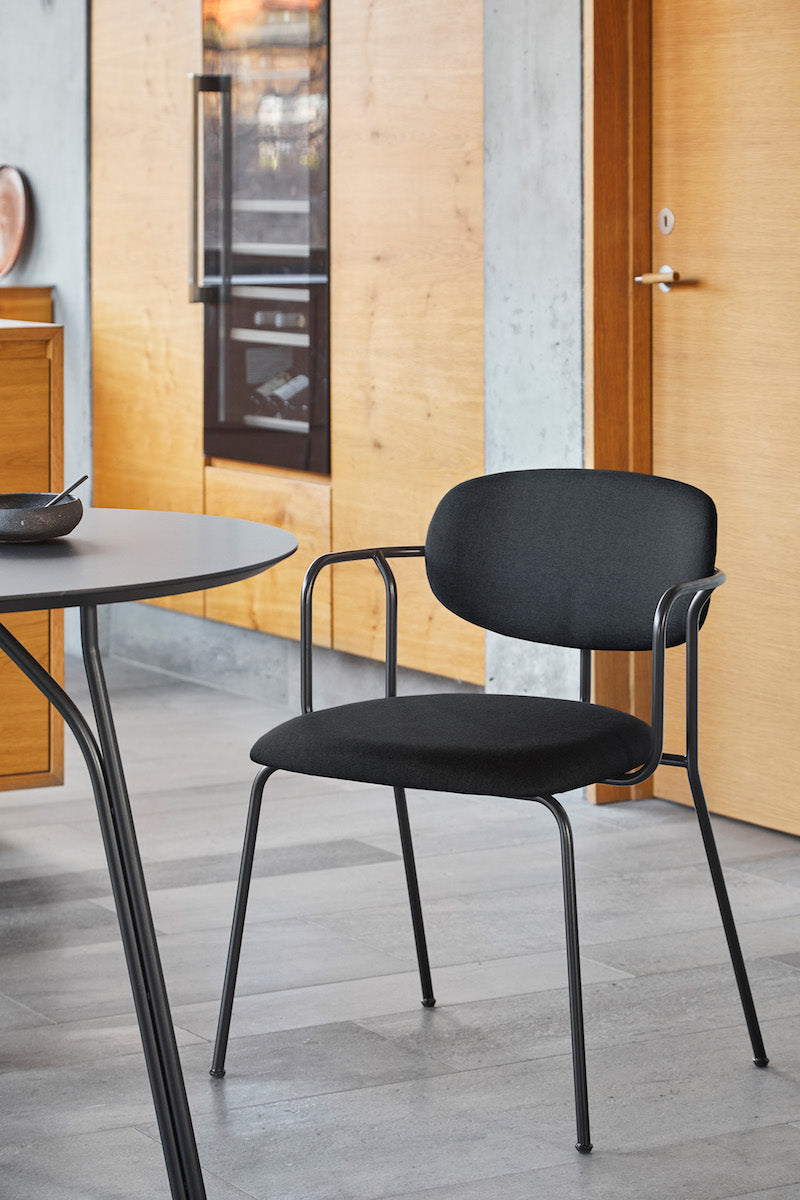
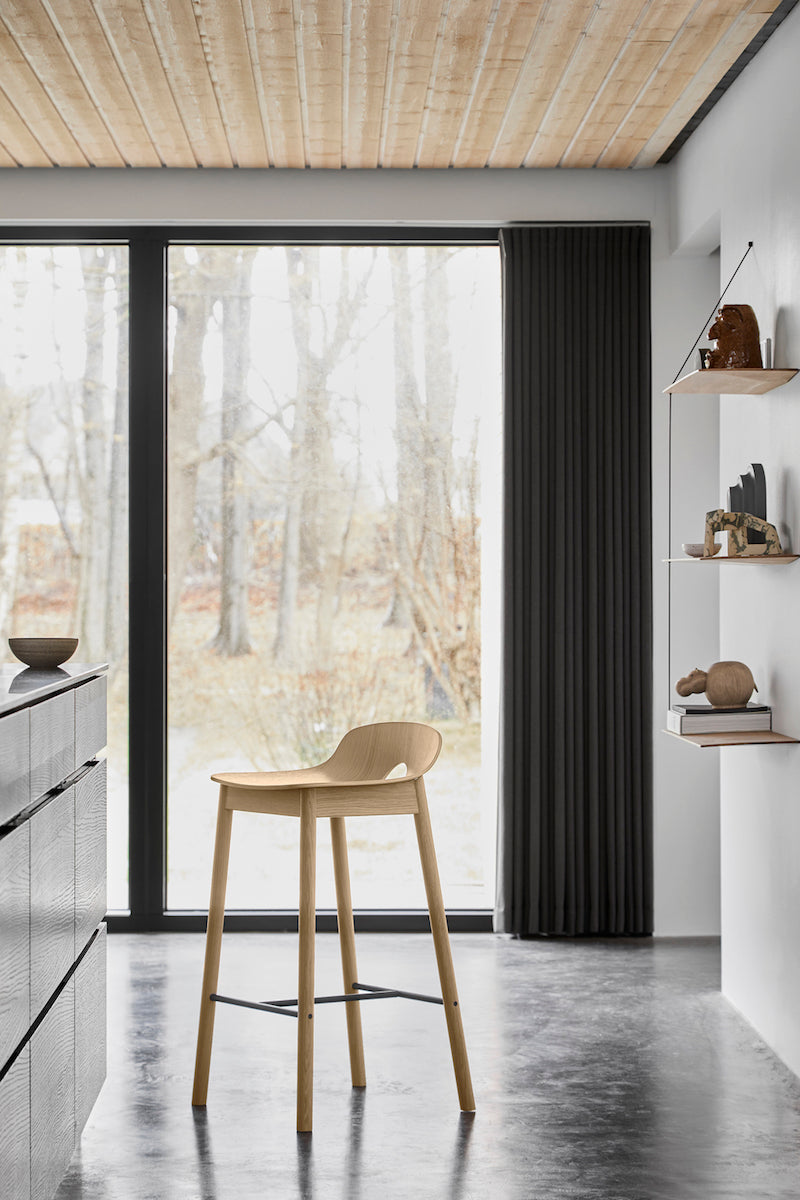
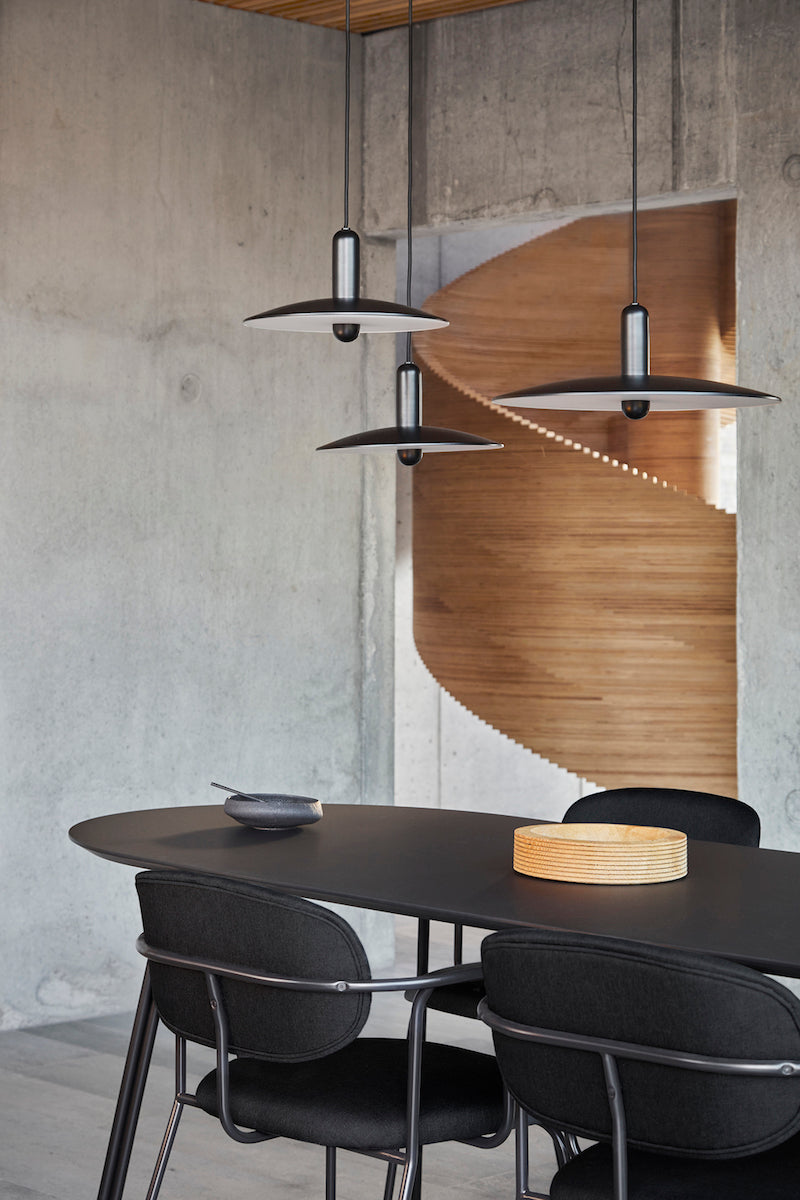
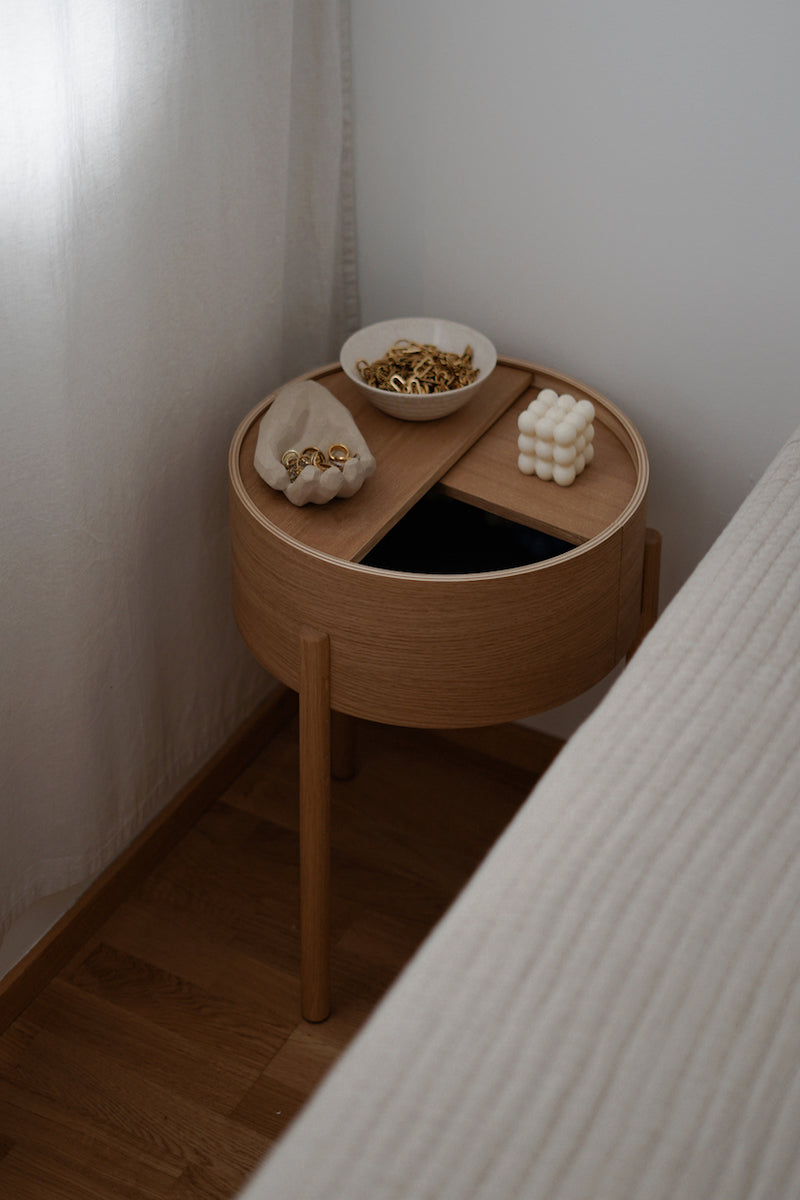
- WOUD (Denmark, 2015) — Brande-based studio working with Norm Architects and Hans-Christian Bauer. Around 76 active products, sitting at the lighter, more minimal end of contemporary Danish design. Designed for small Copenhagen apartments. Translates cleanly into US studios and lofts.
Danish heritage tableware and ceramics
- Kähler (Denmark, 1839) — Denmark's oldest active pottery. Sits inside Rosendahl Design Group (B Corp parent). The Hammershøi tableware line — named for painter Vilhelm Hammershøi — and the Omaggio vase are the easiest entry points. Both stocked through our decor range.
- Holmegaard (Denmark, 1825) — Two centuries of mouth-blown glass on the Danish island of Zealand. The technique has not fundamentally changed. Contemporary catalog draws on Per Lütken (40 years as lead designer) and Jacob E. Bang. Also covered by the Rosendahl Design Group B Corp umbrella.
- Lyngby Porcelæn (Denmark, 1936) — Makes the fluted Lyngby vase, the ribbed columnar piece that shows up in nearly every contemporary Nordic interior shot. Rosendahl Design Group brand. B Corp-covered. Pairs naturally with Kähler ceramics and Holmegaard glass.
- Rosendahl (Denmark) — The design publisher that anchors the group of the same name. Most recognized for Kay Bojesen's wooden Monkey, designed in 1951 and continuously produced ever since. Teak and limba, carved, articulated joints. The same group reissues Arne Jacobsen clocks drawn from the architect's mid-century wall- and table-clock designs. Pillar 4 covers the Monkey's reissue authenticity in depth.
Norwegian sustainable design
- Heymat (Norway, 2008) — Doormats and rugs woven from post-consumer recycled PET — yarn spun from plastic bottles diverted from the waste stream. Small-batch craft production, exterior-grade abrasion testing. Closer to textile design than industrial manufacture. Available in our doormats and rugs range.
- Varier (Norway, 1979) — Peter Opsvik's active-sitting house. The Variable balans stool, designed in 1979, defined a new category — the rocking, kneeling, body-mobile seat that pushes back against the static office chair. Still made in Norway, still in production. Opsvik's other work, including the Gravity recliner and the Ekstrem chair, sits in MoMA's permanent collection.
Danish vs Norwegian — different routes to the same place
Both traditions arrive at sustainability through long-life objects. They start from different places.
| Danish tradition | Norwegian tradition | |
|---|---|---|
| Starting point | Heritage cooperatives, multi-generational houses | Material innovation, ergonomic invention |
| Time horizon | 80–200 years of continuous production | 18–47 years (newer brands, single deep ideas) |
| Hero materials | FSC oak, mouth-blown glass, high-fired stoneware | Recycled PET yarn, laminated wood, steel frames |
| Hero designers | Mogensen, Volther, Koch, Lütken, Bojesen | Opsvik |
| Brands in this guide | FDB Møbler, Mater, WOUD, Kähler, Holmegaard, Lyngby, Rosendahl | Heymat, Varier |
Both share the same endpoint: an object engineered to be kept, not replaced.
The Rosendahl Design Group cluster
Four brands here — Kähler, Holmegaard, Lyngby Porcelæn, and Rosendahl — sit inside Rosendahl Design Group. The group holds B Corp status at the parent level, and the same group publishes the licensed Arne Jacobsen clocks drawn from the Danish architect's mid-century clock designs.
Why consolidation matters
The B Corp audit applies at the group level. Supply chain, governance, worker policy, environmental management — all four brands audited under one umbrella. You don't need to verify each one separately.
The structure has also kept Holmegaard (1825) and Kähler (1839) in continuous production rather than letting heritage names lapse. That keeping-alive is itself a sustainability story.
What it means for buyers
Mix a Lyngby vase, a Holmegaard glass, a Kähler bowl, and a Rosendahl Monkey on one shelf. The certified provenance stays consistent across all four.
The designers worth knowing
Børge Mogensen (1914–1972)
Headed FDB Møbler's design department from 1942. Designed for cooperative pricing — furniture working households could afford. His J39 chair (1944) is among the most-produced Danish chairs in history. Most of the surviving FDB archive is his. Pillar 4 covers the J39 in full.
Poul M. Volther
Designed the J46 dining chair for FDB Møbler. Still in production. Shares Mogensen's commitment to plain materials, honest joinery, forms that read as designed rather than decorated.
Mogens Koch
Designed his modular bookcase system in 1928 — an unusually early example of modular shelving. Still produced at FDB Møbler. Standardized solid-wood modules that stack, combine, and re-purpose across rooms and decades. See it in our storage range.
Kay Bojesen (1886–1958)
Designed the Monkey in 1951. Teak and limba, carved, articulated. One of the most recognized Danish design objects in the world. Produced today by Rosendahl under the Rosendahl Design Group.
Per Lütken
Shaped Holmegaard's modern glass vocabulary across a 40-year career as lead designer. The current Holmegaard catalog draws heavily on his archive, alongside earlier work by Jacob E. Bang.
Peter Opsvik
Norway's most influential living furniture designer. Designed the Variable balans stool for Varier in 1979 — the founding object of the active-sitting category. The Tripp Trapp children's chair (Stokke, 1972) is his too, though that brand sits outside our catalog.
Scandinavian materials, briefly
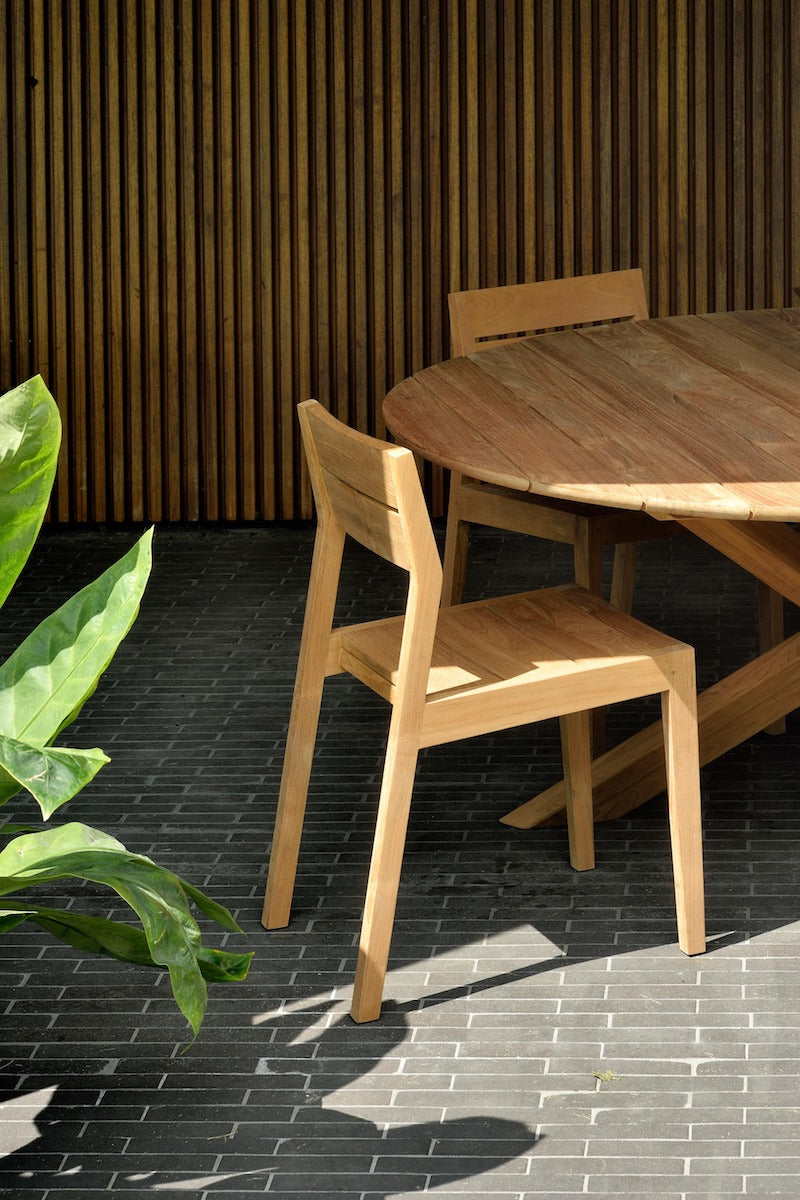
FSC-certified solid oak
The foundation of the FDB Møbler catalog. The Forest Stewardship Council audits forest-to-product chains. An FSC certificate on a Mogensen J39 (in production since 1944) means the timber is traced from managed forest through every step to finished chair.
Mouth-blown glass
Unchanged in fundamental technique since Holmegaard opened in 1825. Molten glass gathered on a pipe, blown free-hand, annealed slowly. Cannot be automated without losing what distinguishes it. Two centuries of continuous practice is itself a form of cultural sustainability.
Matek composite
Patented at Mater. Reuses industrial waste — coffee husk, mussel shell, recycled plastic — as load-bearing material for actual seating and tables. One of the few proprietary circular materials in Scandinavian furniture to move from prototype to volume production.
Recycled PET yarn
Spun from post-consumer plastic bottles. The material story at Heymat. Each Norwegian-woven doormat diverts a measurable weight of PET from the waste stream. Fiber tests at exterior-grade abrasion resistance — recycling that holds up, not recycling that crumbles.
Danish high-fired stoneware
Kähler fires clay at temperatures that vitrify the body completely. Non-porous, chip-resistant, food-safe for decades. Combined with nearly two centuries of production history, it is durability of a kind retail ceramics rarely match.
A useful rule for any Scandinavian product page: count the named facts. A designer, a year, a certificate, a parent company — that tells you something. "Nordic-inspired, eco-friendly, minimalist" tells you nothing.
How to choose
Talk to yourself about the room first. Then pick a path.
If you want continuous-production heritage
Start with the FDB Møbler J39 chair (since 1944) or Holmegaard mouth-blown glass (since 1825). Both come from manufacturers that have not paused through wars, recessions, or trend cycles.
If you want a certified B Corp specifically
Mater holds its own B Corp. The four Rosendahl Design Group brands — Kähler, Holmegaard, Lyngby Porcelæn, Rosendahl — sit under the group's B Corp parent. Five of nine brands here are covered.
If you want recycled-material furniture
Heymat doormats (post-consumer PET, woven in Norway) and Mater's Matek composite (industrial waste cast as structure) are the two strongest circular stories in the Scandinavian range.
If you want named-designer history
FDB Møbler for Mogensen, Volther, Koch. Rosendahl for Bojesen. Holmegaard for Lütken and Bang. Varier for Opsvik. Each archive is deep enough to anchor a whole room.
If you want ergonomic invention
Varier. Opsvik's active-sitting category, still made in Norway, still in production since 1979.
If you want a starter piece
A Kähler vase, a Lyngby fluted vase, or a Kay Bojesen Monkey from Rosendahl. Entry-priced. Introduces the certifications and heritage without committing to a furniture purchase.
Frequently asked questions
What makes a furniture brand "Scandinavian"?
Founded and headquartered in Denmark, Norway, Sweden, Finland, or Iceland. Design archive drawing on the Nordic tradition — named designers, restrained palettes, continuous-production pieces over seasonal collections. Every brand in this guide is Danish or Norwegian.
Which Scandinavian brands hold B Corp certification?
Mater is independently B Corp certified. Kähler, Holmegaard, Lyngby Porcelæn, and Rosendahl all sit under Rosendahl Design Group's B Corp at the group level. Five of nine brands here are covered.
Is FDB Møbler the oldest brand in this guide?
No. Holmegaard (1825) and Kähler (1839) are both older. The chronology runs: Holmegaard 1825, Kähler 1839, Lyngby Porcelæn 1936, FDB Møbler 1942, Varier 1979, Mater 2006, Heymat 2008, WOUD 2015.
Who designed the Lyngby vase?
The fluted Lyngby vase originated with Lyngby Porcelæn in 1936. Ribbed, columnar porcelain. Currently produced under Rosendahl Design Group's B Corp parent.
What's the difference between Danish and Norwegian sustainable design?
Danish tradition here is heritage-led — cooperatives, multi-generational tableware houses, continuously produced archives. Norwegian entries (Heymat, Varier) are material-led and ergonomic-led. Both meet at the same point: objects engineered for long life.
Are these brands hand-made or factory-produced?
Both, depending on the object. Holmegaard is mouth-blown by hand. Kähler involves hand-finishing on a partly mechanized line. Heymat is woven in small batches. FDB Møbler wood furniture and Mater composite are factory-produced in Denmark or European supply contracts, with hand assembly and finishing.
How long do these pieces typically last?
The continuous-production pieces are the strongest answer. The Mogensen J39 chair has been in production since 1944. The Mogens Koch bookcase system since 1928. Treated with normal household care, Holmegaard glass and Kähler ceramics are multi-decade objects. These brands are not built for a replacement cycle.
Which brand has the deepest US warehouse selection?
FDB Møbler at roughly 462 active products — the deepest single Scandinavian brand and the deepest single brand at Comosum overall. WOUD (about 76 products) and the four Rosendahl Design Group brands together cover the broader tableware and decor catalog.
Browse the full Scandinavian range, see the Sustainability Meter rubric, or compare against the twelve broader European brands and the mid-century reissue archive. Each brand collection above is one click from this page.
Comosum is also a proud member and advocate of Be Original Americas, the leading organization dedicated to supporting and protecting original design. Be Original Americas promotes the economic, ethical, and environmental value of authentic design, encouraging both creators and consumers to understand why originality matters. Through our membership, we stand alongside a global community that values creativity, innovation, and craftsmanship.
Being part of Be Original Americas reinforces our belief that great design should respect its creators and the planet. It’s a commitment to authenticity — ensuring that every piece we offer honors the artistry, sustainability, and integrity that define original design.
Comosum is also a proud member and advocate of Be Original Americas, the leading organization dedicated to supporting and protecting original design. Be Original Americas promotes the economic, ethical, and environmental value of authentic design, encouraging both creators and consumers to understand why originality matters. Through our membership, we stand alongside a global community that values creativity, innovation, and craftsmanship.
Being part of Be Original Americas reinforces our belief that great design should respect its creators and the planet. It’s a commitment to authenticity — ensuring that every piece we offer honors the artistry, sustainability, and integrity that define original design.